Recent AI Projects

I design and prototype AI-powered products. My work focuses on turning emerging AI capabilities into practical tools and meaningful user experiences. I use rapid prototyping tools and AI APIs to explore new product concepts and interaction models.
See How I Design AI Products
AI-assisted math game built with Famous.ai
Overview
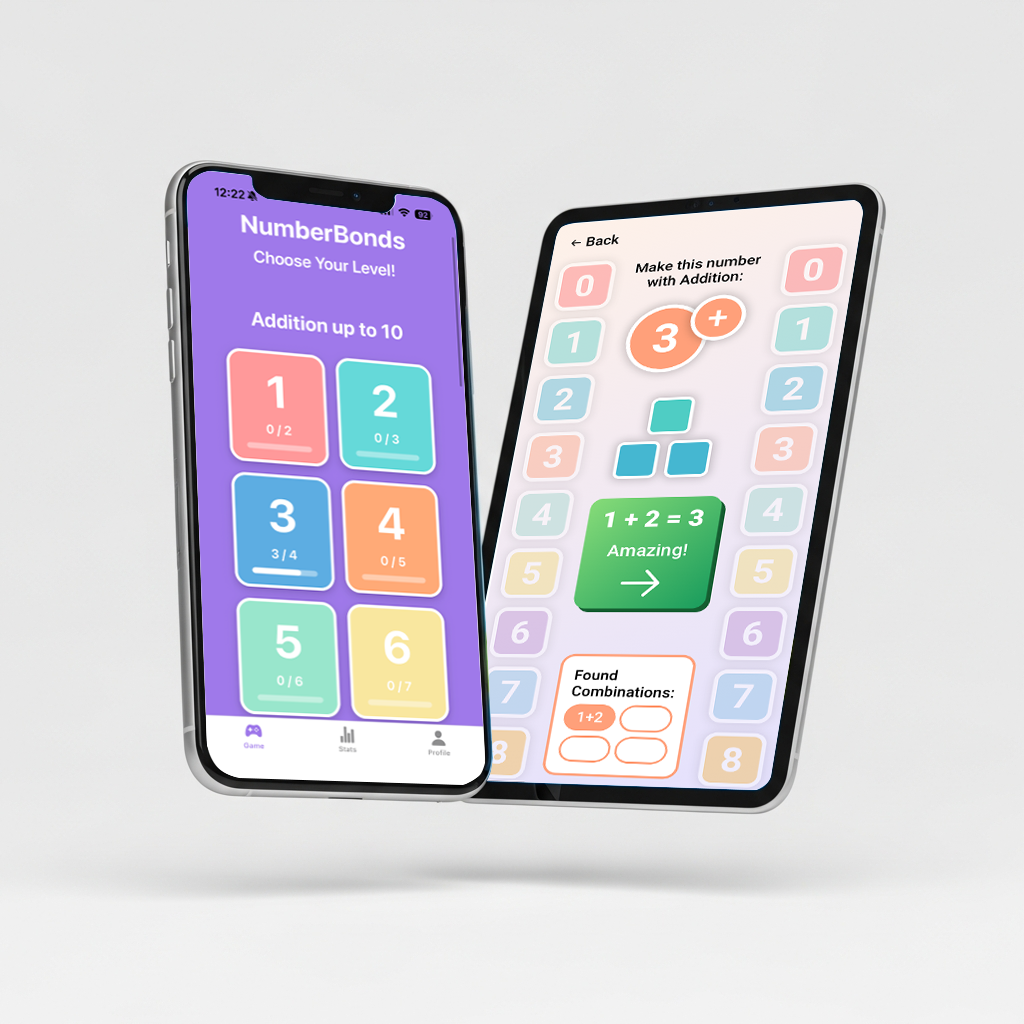
NumberBondz is a learning concept designed to help children master number bonds through playful interaction rather than repetitive exercises.

The project explores how mathematical relationships can be learned through visual interaction, game mechanics and adaptive learning.

Problem
Children often learn number bonds through memorisation instead of understanding how numbers relate to each other. This approach can make maths feel abstract and frustrating, especially for early learners.

Idea
Create a system where numbers behave like objects that can connect together. Children discover that certain number combinations form a target value such as 5 or 8 by combining them.

Instead of solving equations, they build number bonds through interaction.

Solution
NumberBondz turns number practice into a puzzle based experience where children combine numbers to reach a target value and complete challenges.

The system introduces concepts progressively:
• recognising number pairs
• building numbers through combinations
• developing mental arithmetic speed
• understanding flexible number relationships

Simple visuals and immediate feedback reinforce learning while keeping the experience playful and engaging.

Prototype
I used a no-code AI app builder to design, build and deploy the app to the Google Play Store and Apple App Store. The process started with a carefully structured prompt and evolved through multiple iterations based on real user feedback.

Future Exploration - AI Assisted Learning
Future versions of the concept could introduce adaptive learning powered by AI.

The system could:
• analyse how quickly children recognise number pairs
• identify patterns in mistakes
• adapt difficulty levels dynamically
• generate personalised challenges for each learner

This would allow NumberBondz to evolve into a personalised maths learning platform, helping each child progress at their own pace.

Role
Product design, prototyping, deploying

NumberBondz

Vibe Coding
Download the App
Built with Airtable + Placid
Overview
This project explores how structured user-generated content can be automatically transformed into ready-to-publish video assets. The goal was to eliminate repetitive manual editing work and create a scalable system for producing consistent marketing content across multiple platforms.

Problem
Creating promotional video content often requires significant manual work, including editing footage, adding voiceovers, inserting branding elements, and adapting formats for different platforms. When content is generated frequently, this process becomes slow, expensive, and difficult to scale.

Idea
Design an automated workflow where structured content submitted by users can automatically generate fully formatted video assets without requiring manual editing.

Solution
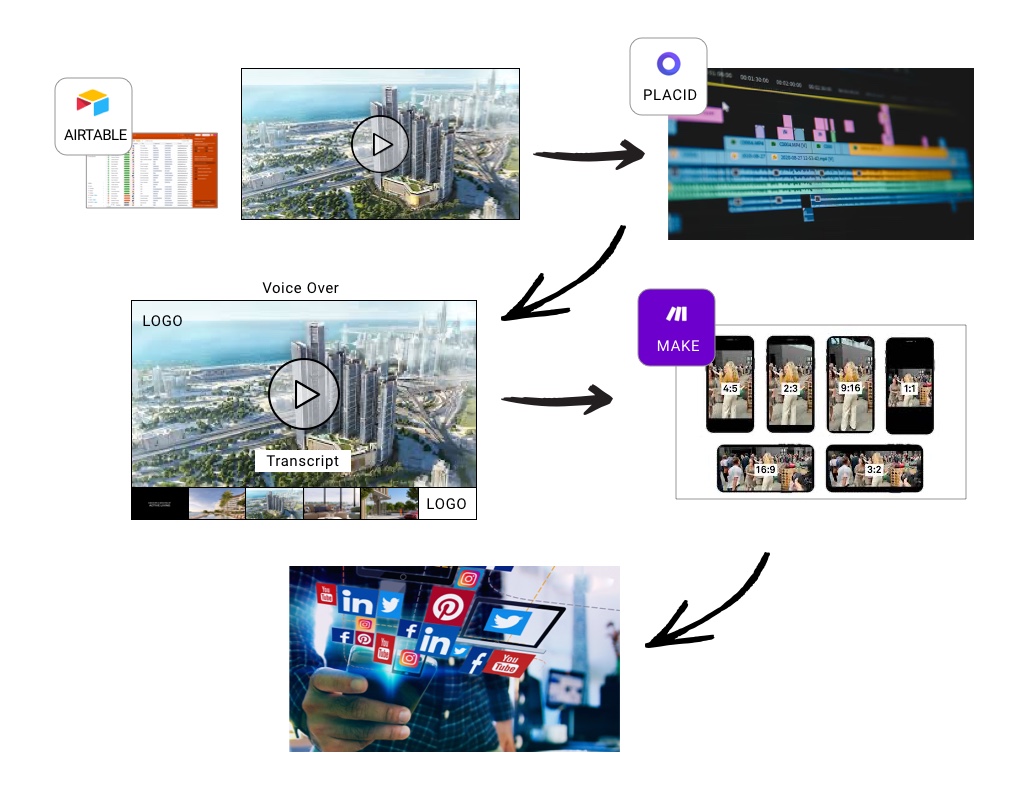
I designed an end-to-end automation pipeline using Airtable as the structured content source and Placid as the video rendering engine.

The workflow processes user-generated content and automatically generates video outputs with predefined layouts, branding, and voiceover elements.

The system performs the following steps:
• collect structured content in Airtable
• process media and metadata
• generate video compositions using templates
• export ready-to-publish assets
• automatically prepare social media formats

This approach turns content creation into a repeatable production pipeline rather than a manual design task.

Outcome
Instead of designing each video individually, teams can generate consistent branded assets automatically from a single content source.

Role
Template design, AI workflow design
User-Generated Content → Automated Video Output

AI Workflow Automation
AI-powered content generation & subscription automation built with Bubble
Problem
Children often lose interest in reading because books are static and cannot adapt to their interests or reading level.

Idea
Create a storytelling system where children receive personalised story chapters by post, and their choices influence what happens next in the story.

Prototype
I used a no-code visual programming platform to design the application and user interfaces. Interface components were designed in Figma and integrated into the platform. AI APIs were used to generate story chapters and illustrations that remain consistent with the evolving storyline.

Solution
I built a web platform that uses AI to generate story chapters and illustrations based on a child’s profile, reading level and previous story events. Parents manage subscriptions and children’s profiles through a dashboard while the system automatically generates the next chapter.

Outcome
A fully automated storytelling pipeline combining AI generation, subscriptions, and personalised narrative progression.

Role
Idea, design, implementation

Pretty Little Envelope

Automated AI pipeline
Visit the Website
Built with Figma make
Problem
Video calls between grandparents and young children often feel awkward and children quickly lose interest.

Idea

Start the interaction with a shared activity instead of an empty call.

Solution
BeThere combines live video with simple games such as tic tac toe or drawing. The shared activity becomes the centre of the interaction, helping conversations emerge naturally.

Design
The goal was to create the feeling that grandparents and children are sitting in the same room, with a shared game surface acting as the space between them.

Prototype
Built as a high-fidelity interactive prototype using an AI-powered tool that transforms text prompts and static designs into functional prototypes.

Outcome
Demonstrates a new interaction model for family communication built around play rather than conversation.

Role
Design, prototyping

Be-There

Rapid Prototyping with AI
Check the Prototype